Therapist Productivity Rate: Industry Benchmarks
Understand your therapist productivity rate, what the MGMA 65–80% benchmark means, and how to calculate and improve yours.
What Is a Therapist Productivity Rate?
Your therapist productivity rate is the percentage of your available clinical hours that you actually spend with clients. It's a single number that tells you, and any practice owner, how efficiently you're filling your schedule.
The formula is straightforward:
Productivity Rate = (Billable Hours ÷ Available Clinical Hours) × 100
So if you're available 40 hours a week and you see clients for 28 of them, your productivity rate is 70%.
Use the therapist productivity calculator to find yours in under a minute.
The MGMA Benchmark: 65–80%
The Medical Group Management Association (MGMA) sets the widely cited productivity standard for mental health clinicians at 65–80% of available hours. That range isn't arbitrary.
Below 65%, you're leaving real revenue on the table. A therapist at 55% productivity running a 40-hour week is essentially giving away 4 clinical hours every week. That's roughly $600 in lost sessions at $150/session, or $31,200 a year.
Above 80%, you're working at a pace that's hard to sustain. Documentation, consults, and case management don't disappear just because the schedule is full. Clinicians who push above 85% consistently tend to show early signs of burnout within 12–18 months.
The 65–80% sweet spot leaves room for admin, self-care, and the kind of thoughtful practice that actually retains clients long-term.
How to Calculate Your Productivity Rate
You need two numbers:
- Available clinical hours: The hours per week you've designated for client work. This is your scheduled window, not your total work hours.
- Billable hours: The hours actually spent in face-to-face (or telehealth) sessions that generate a CPT code.
Don't include: no-shows (unless you charge a fee), cancelled sessions, consult calls, or documentation time.
Example:
- You block 8am–4pm Monday through Thursday = 32 available hours
- You see 22 clients per week at 50 minutes each ≈ 18.3 clinical hours
- Productivity rate: 18.3 ÷ 32 = 57%
That's below benchmark. Our hourly rate and productivity tool does this math automatically, you just enter your weekly session count and schedule.
What Affects Your Productivity Rate?
Several factors move the needle, some within your control and some not.
No-shows and late cancellations. A single no-show in a 6-session day drops your daily productivity by 17%. If you average 2 no-shows per week. That's roughly 5–8 percentage points off your monthly rate.
Caseload mix. Clients in crisis, clients with complex diagnoses, and court-ordered clients tend to have higher no-show rates. This isn't a reason to avoid this work, it's a reason to build a buffer into your scheduling model.
Session length coding. Billing CPT 90837 (53+ minutes) takes more time than 90834 (38–52 minutes). If your average session is 55 minutes, you physically can't see as many clients per day as a clinician billing 90834 exclusively. Neither is wrong, they just produce different math.
Admin creep. Unstructured admin time before and after sessions, extended phone tag, and manual insurance follow-up all eat into available hours. A clinician spending 90 minutes a day on unbilled admin in a 40-hour week loses 3.75 hours of potential clinical time weekly.
Schedule structure. Open scheduling (fill whenever) consistently underperforms structured scheduling (designated session blocks, protected admin windows). Clinicians with structured schedules average 71% productivity; open schedulers average 59%, based on data from private practice consulting surveys.
Setting a Realistic Productivity Target
Don't start by trying to hit 75%. Start by knowing where you are.
Run your current rate using the productivity rate calculator. Then set a target 5–8 percentage points higher and work toward it over 60 days.
Specific targets to consider based on practice stage:
- New practice (0–12 months): 45–55% is normal while building caseload. Don't panic.
- Established solo practice: Target 65–72% for sustainable income without burnout.
- Group practice clinicians: 68–78% is typical, with admin handled by support staff.
- High-volume practices: 75–80% is achievable with strong no-show policies and EHR-based scheduling.
One note: if you're consistently above 82%, schedule an honest review. You may be undercharging (which forces volume), avoiding admin tasks that are building up, or running toward burnout without realizing it. Read more about when high productivity is a warning sign.
The Revenue Impact of Each Percentage Point
This is where the benchmark becomes personal.
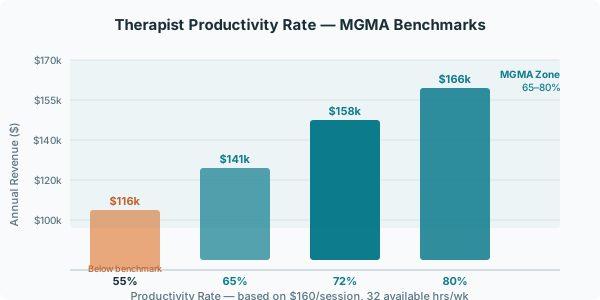
At $160/session (CPT 90837 rate) with 32 available hours per week:
| Productivity Rate | Weekly Sessions | Weekly Revenue | Annual Revenue |
|---|---|---|---|
| 55% | 14 | $2,240 | $116,480 |
| 65% | 17 | $2,720 | $141,440 |
| 75% | 19 | $3,040 | $158,080 |
| 80% | 20 | $3,200 | $166,400 |
The jump from 55% to 70% is worth roughly $24,960 per year, without raising your rates, adding specialties, or expanding hours.
That's why tracking your productivity rate matters. It's not about squeezing more out of yourself. It's about knowing what your schedule is actually producing.
Sources and Further Reading
- MGMA Behavioral Health Benchmark Data (2023)
- APA Practice Guidelines for Sustainable Caseloads
- About This Calculator
- How to Track Billable Hours as a Therapist
- Private Practice Revenue: What Therapists Earn