Burnout vs Low Productivity: Know the Difference
Therapist burnout and low productivity look similar but need different fixes. Learn the signs, the 80%+ danger zone, and when fewer clients is the right call.
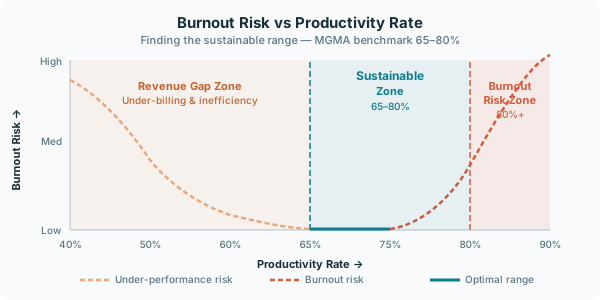
They Look the Same. They're Not.
A therapist seeing 16 sessions per week when they've scheduled 25 might be burned out. Or they might have a scheduling problem, a no-show problem, or a caseload mix problem. The productivity number doesn't tell you which one it is.
Getting this distinction wrong is expensive, in both directions. Treating burnout like a business inefficiency problem leads to pushing clinicians harder when they need support. Treating a business problem like burnout leads to pulling back caseload when what's actually needed is a systems fix.
The therapist productivity calculator can show you your productivity rate. What it can't show you is why it's low. That requires a different kind of assessment.
What Burnout Actually Looks Like
Burnout in therapists isn't just exhaustion. The clinical definition from Maslach & Jackson's burnout inventory covers three dimensions:
- Emotional exhaustion: feeling drained by the clinical work itself, not just physically tired
- Depersonalization: emotional distancing from clients, cynicism about outcomes, going through the motions
- Reduced personal accomplishment: feeling ineffective, questioning clinical competence
A burned-out therapist may look productive on paper while experiencing all three internally. Or the burnout may already be showing up in the numbers: an increase in client dropouts, documentation that's falling weeks behind, or a spike in clinician-initiated cancellations.
Key behavioral signs to watch for:
- Documentation turnaround slipping from same-day to 3+ days
- Dreading specific clients or client types (not occasional, consistently)
- Fatigue that doesn't resolve after a weekend
- Shortened sessions not due to clinical rationale
- Appetite changes, sleep disruption, increased irritability outside work
These are not productivity problems. These are health signals.
What Business Inefficiency Looks Like
Low productivity from business problems has a completely different fingerprint.
A therapist with a systems problem typically:
- Is available and willing to see more clients
- Has empty slots on their schedule they can't fill
- Doesn't dread the work itself
- Shows inconsistent no-show management
- Has never implemented a cancellation policy
Low productivity from inefficiency often traces to:
- No-show rate above 12–15% without a mitigation strategy
- Schedule structure that doesn't protect clinical blocks
- Slow follow-up on new client inquiries (more than 48 hours)
- Insurance credentialing delays that limit referral intake
- Lack of a clear specialty or referral source strategy
These have concrete fixes. A cancellation policy, automated reminders, and a waitlist system can move a practice from 52% to 70%+ productivity within 60–90 days without the clinician seeing more total hours.
When Low Productivity Is Actually Healthy
Not every low productivity rate signals a problem.
A therapist who intentionally works 15–18 sessions per week because they're also raising young children, writing a dissertation, or managing a health condition isn't underperforming. They're choosing a sustainable pace. The benchmark range exists for practices targeting maximum clinical productivity, it's not a moral standard.
Similarly, clinicians working with trauma, severe mental illness, or high-acuity populations may appropriately carry lighter caseloads. Compassion fatigue is real. Seeing 25 high-trauma clients per week is not comparable to seeing 25 clients with subclinical anxiety. The emotional labor content matters.
New practice owners are also often running 40–50% productivity for 6–12 months, not because they're doing something wrong, but because caseload building takes time. A solo practice hitting 55% in month 6 is on a normal trajectory.
The 80%+ Productivity Danger Zone
The MGMA upper benchmark of 80% is a ceiling recommendation, not a target.
Consistently operating above 82–85% productivity creates specific risks:
- Documentation debt: Notes fall behind when every hour is session time. Documentation debt compounds quickly, a week of delayed notes becomes a month, then a licensing board concern.
- No buffer for complexity: When a scheduled 50-minute session runs long due to a crisis disclosure, you need 10 minutes of transition time. A packed schedule doesn't have it.
- Reduced therapeutic presence: The quality of the 25th session in a week rarely equals the 12th. Research on provider fatigue in psychotherapy shows measurable decrements in therapist responsiveness after 20+ clinical hours/week.
- Referral network atrophy: Clinicians at capacity stop attending networking events, responding to peer consultations, and maintaining the professional relationships that feed future referrals.
If your productivity rate is consistently above 82%, the right question isn't "how do I maintain this?", it's "what happens to my practice and my health if this continues for another year?"
Signs You Need Fewer Clients, Not More Systems
Sometimes the most productive thing a therapist can do is reduce caseload. Here's when that's likely true:
- You've already implemented the standard no-show and scheduling systems
- Your productivity rate is at or above 78%
- You're experiencing 2+ burnout symptoms from the Maslach criteria above
- Your consultation or professional development has dropped to near zero because there's no time
- You're billing maximum CPT code sessions but retaining clients at a lower rate (churning)
Reducing from 28 sessions/week to 22 doesn't have to mean a proportional income reduction. If the quality of your clinical work and client retention improves, the math often works out: fewer sessions with longer average client tenure and better outcomes can produce similar or higher revenue.
Recovery Strategies for Burned-Out Therapists
If burnout is the actual diagnosis, systems tweaks won't help. What does:
Reduce clinical hours, at least temporarily. Even a 3-session reduction per week for 6–8 weeks creates meaningful relief. Use the productivity and revenue tool to model what a temporary reduction costs, it's usually less than expected.
Schedule non-clinical time as protected blocks. Consultation, peer supervision, continuing education, and admin time should appear on your calendar as fixed appointments, not "whatever's left."
Get your own supervision or therapy. Obvious advice that clinicians routinely ignore for themselves. The parallel process between clinician self-care and client outcomes is well-documented.
Review caseload mix, not just size. Sometimes it's not the number of clients, it's the acuity concentration. If 70% of your caseload is complex trauma and you have no lighter cases, even 18 sessions can feel like 30.
Sources and Further Reading
- Maslach & Jackson, Burnout Inventory (MBI) Technical Manual
- Figley, C.R., Compassion Fatigue: Coping with Secondary Traumatic Stress
- NASW Code of Ethics, Self-Care Standards
- About This Calculator
- Therapist Productivity Rate: Industry Benchmarks
- Managing Productivity in a Group Practice