How to Track Billable Hours as a Therapist
Learn what counts as billable hours for therapists, common tracking mistakes that cost revenue, and a simple weekly review system.
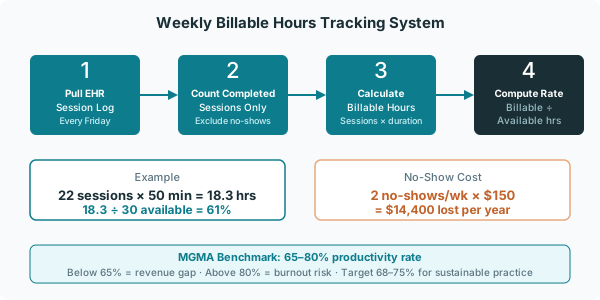
Billable Hours: The Number That Runs Your Practice
Billable hours for therapists are the hours you spend in direct client contact, sessions that generate a CPT code and get submitted to insurance or charged to a client. That's it.
Not documentation. Not phone consults. Not team meetings. Not the 20 minutes you spent reviewing records before a new intake.
Getting clear on this distinction matters more than most therapists realize. When you conflate "working hours" with "billable hours," you can't accurately track your therapist productivity rate, set revenue targets, or spot where time is leaking.
What Actually Counts as Billable
Billable:
- Individual therapy sessions (CPT 90837, 90834, 90832)
- Group therapy sessions (CPT 90853)
- Family sessions with the identified client present (CPT 90847)
- Psychological testing and evaluation (when billed by time)
- Crisis intervention sessions with a documented CPT code
Not billable (at standard insurance rates):
- Session notes and documentation
- Phone consults under 16 minutes (though some insurers allow 98966–98968 for phone E&M)
- Coordination of care calls (unless separately coded, CPT 99366)
- Missed sessions / no-shows (unless you have a private-pay late cancellation fee)
- Travel between clinic locations
- Supervision hours (for supervisees, supervisors may bill differently)
A common mistake: therapists count their documentation time inside the "session hour" and then wonder why revenue projections are off. A 53-minute session (90837) starts and ends with the client. The 15 minutes of notes after are overhead.
The 4 Most Common Tracking Mistakes
1. Estimating instead of recording.
Trying to remember at the end of the week how many sessions you held is unreliable. Memory compression is real. Most clinicians underestimate by 1–2 sessions per week when they rely on recall. Use your EHR's session log, not your memory.
2. Counting no-shows as billable.
A no-show is lost revenue, not billable time, unless you have a documented late cancellation/no-show fee policy and actually collect it. Track no-shows separately so you can see their true cost. Two no-shows per week at $150/session = $15,600 in lost annual revenue.
3. Mixing clinical and admin blocks.
If you block 9am–5pm as "work time" but only 6 of those hours are sessions, your unofficial productivity rate looks like 75% when it's actually closer to 55% of realistic clinical hours. Separate your schedule: clinical blocks, admin blocks, and open time.
4. Not counting partial weeks.
Vacations, sick days, and trainings reduce available hours but don't change your baseline calculation. Track actual weeks worked to get accurate annual projections. A therapist seeing 25 sessions per week for 48 weeks (allowing 4 weeks off) earns differently than one running a 52-week math model.
Simple Tracking Systems That Work
You don't need a complex system. You need a consistent one.
Option 1: EHR session log review (best for most)
Every Friday, pull your weekly session report from your EHR (SimplePractice, TherapyNotes, Jane App, etc.). Record:
- Total sessions completed
- No-shows / late cancellations
- Available hours that week
That's your weekly data. Takes 5 minutes.
Option 2: Weekly tally sheet
A simple spreadsheet with columns: Date, Client (initials), CPT Code, Session Length, Completed Y/N. Update it same-day. At week end, sum the completed rows.
Option 3: Calendar block method
Color-code your calendar: green = completed session, red = no-show, yellow = late cancel. At week end, count greens. This works particularly well for visual thinkers.
Whatever you choose, do it the same way every week. Consistency beats complexity.
How Billable Hours Connect to Your Productivity Rate
Once you're tracking billable hours accurately, the productivity rate calculation is simple:
Productivity Rate = (Billable Hours ÷ Available Clinical Hours) × 100
If you hold 22 sessions at 50 minutes each in a week where you have 30 clinical hours available:
- Billable hours: 22 × 0.83 hr = 18.3 hours
- Rate: 18.3 ÷ 30 = 61%
Plug your numbers into the therapist session revenue calculator to see what that productivity rate means for your monthly and annual income.
The MGMA benchmark is 65–80%. If you're below 65%, the billable hours tracker is the first place to look, not your rates, not your specialty. See our full productivity rate guide for how each percentage point affects income.
The Weekly Review: A 10-Minute Process
Building a weekly review habit does more for practice health than any fancy system. Here's a simple process:
Every Friday, answer these 4 questions:
- How many sessions did I complete this week?
- How many no-shows or late cancels did I have?
- What was my available clinical time this week?
- What's my productivity rate this week?
Write the numbers down somewhere you'll see them. Track them month over month. After 8 weeks, patterns emerge: you'll see which days have the worst no-show rates, which client types cancel most, and whether your overall trend is moving up or down.
This 10-minute review is the difference between managing your practice and reacting to it.
Setting a Weekly Billable Hours Goal
Work backward from income:
- Decide your annual revenue target (e.g., $120,000)
- Divide by sessions per year at your rate (e.g., $150/session → 800 sessions needed)
- Divide by weeks worked (e.g., 48 weeks → 16.7 sessions/week)
- Add a 10–15% buffer for no-shows → target 19–20 sessions per week on the schedule
That's your weekly billable hours target. Not a vague goal to "see more clients", a specific number that ties directly to your income.
Sources and Further Reading
- APA Practice Management Guidelines (2024)
- NASW Standards for Documentation
- About This Calculator
- Therapist Productivity Rate: Industry Benchmarks
- 7 Ways to Reduce No-Shows in Your Practice