Private Practice Revenue: What Therapists Earn
See real private practice revenue ranges for therapists, how session rate affects annual income, and the math behind breaking six figures.
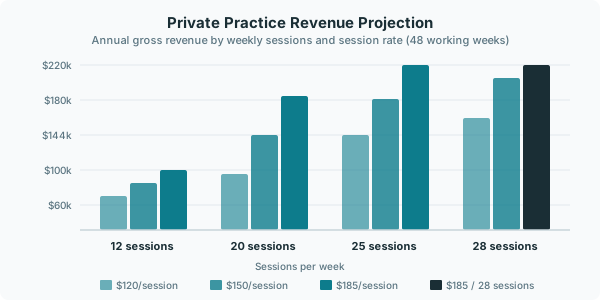
What Therapists Actually Earn in Private Practice
Private practice revenue varies more than most therapists expect, and the gap between a struggling solo practice and a thriving one often comes down to three variables: session rate, weekly volume, and weeks worked per year.
The median net income for a full-time private practice therapist in the U.S. sits around $68,000–$85,000. The top 25% clear over $100,000. The bottom quartile earns under $55,000.
Those numbers mean very different things depending on overhead, location, insurance mix, and caseload structure. Let's break down the math.
Income Ranges by Practice Type
Here's a realistic snapshot based on 2024 private practice data:
| Practice Type | Annual Sessions | Rate/Session | Gross Revenue |
|---|---|---|---|
| Part-time (15 sessions/wk, 48 wks) | 720 | $130 | $93,600 |
| Full-time insurance (25 sessions/wk, 48 wks) | 1,200 | $110 | $132,000 |
| Full-time private pay (25 sessions/wk, 48 wks) | 1,200 | $175 | $210,000 |
| Group practice W2 (28 sessions/wk, 50 wks) | 1,400 | $70 (after split) | $98,000 |
Note: gross revenue doesn't account for overhead. Solo private pay practices typically net 75–85% of gross. Insurance practices net 65–75% after billing costs, credentialing overhead, and write-offs.
Use the private practice revenue calculator to plug in your own session rate and weekly volume.
How Session Rate Moves the Revenue Needle
This is the most under-appreciated lever in private practice finance. A $20 rate increase affects your income more than most therapists expect.
At 25 sessions per week, 48 working weeks:
- $120/session → $144,000/year gross
- $140/session → $168,000/year gross
- $160/session → $192,000/year gross
- $185/session → $222,000/year gross
That's a $78,000 swing between a $120 and $185 session rate, for the exact same number of clients, same hours, same effort.
If you're doing insurance billing, you don't fully control this number. CPT 90837 reimburses anywhere from $85 (Medicaid) to $175 (some commercial plans) depending on your state and payer. Private pay gives you full control.
Full-Time vs Part-Time Math
Many therapists run what's functionally a part-time caseload but call it full-time because their administrative work fills the rest of the week.
A true full-time direct-care schedule looks like 25–30 client-facing hours per week. That's 25–30 sessions if you bill 90837, or more sessions if you use shorter CPT codes.
Part-time definitions vary, but 12–18 sessions per week is typical for someone building a practice, managing young children, or carrying a separate salaried position.
At $150/session:
- 12 sessions/week × 48 weeks = $86,400/year
- 20 sessions/week × 48 weeks = $144,000/year
- 28 sessions/week × 48 weeks = $201,600/year
The difference between 12 and 28 sessions per week is roughly $115,000 annually. Whether that's achievable, and sustainable, depends heavily on your no-show rate, productivity rate, and burnout threshold.
Insurance vs Private Pay: The Revenue Reality
Insurance panels provide a built-in referral stream and lower client acquisition friction. But the revenue math can be painful.
A therapist billing insurance at an average of $110/session (blended across plans) seeing 25 clients/week:
- Gross: $137,500/year
- Minus billing costs (~8%): $11,000
- Minus write-offs (~12%): $16,500
- Net: ~$110,000
The same therapist going fully private pay at $165/session, same volume:
- Gross: $206,250/year
- Minimal billing overhead: ~$1,500
- Net: ~$204,750
That $94,750 gap is real. The catch: private pay requires active marketing, a waitlist-building strategy, and clients who can self-pay. Not every market supports $165+ rates.
Hybrid models, 50% insurance, 50% private pay, are increasingly common. They preserve accessibility while improving the revenue floor. See insurance vs private pay: productivity impact for a deeper comparison.
Breaking Six Figures: The Actual Math
Earning $100,000+ in private practice gross revenue requires one of these combinations:
Path 1: Volume
667 sessions per year at $150/session. That's about 14 sessions/week for 48 weeks. Achievable at an insurance rate if volume is sustainable.
Path 2: Rate
20 sessions/week at $100/session for 50 weeks = $100,000. Same sessions, lower rate, you need more of them. Or: 20 sessions/week at $150/session for 34 weeks. Higher rate buys flexibility.
Path 3: Rate + Volume
25 sessions/week at $160/session for 48 weeks = $192,000. This is where many established private pay practices land.
The fastest path to six figures for most therapists isn't adding more sessions, it's raising rates to private pay levels while maintaining 22–25 billable sessions per week.
Run your own projections with the therapist income calculator. Enter your session rate, weekly target, and weeks worked, it'll show you exactly where you land.
Overhead: The Number That Changes Everything
Gross revenue is a vanity metric. What matters is net.
Typical overhead categories for a solo private practice:
- Office rent: $500–$1,800/month (if in-person)
- EHR/billing software: $50–$100/month
- Liability insurance: $100–$200/year
- Credentialing and insurance admin: 5–10% of insurance revenue
- Continuing education: $500–$2,000/year
- Professional memberships (APA, NASW, etc.): $200–$500/year
Telehealth-only practices eliminate rent entirely, which can add $6,000–$21,600 to net income per year compared to office-based practices at similar gross revenue. See telehealth vs in-person productivity for a full comparison.
Sources and Further Reading
- NASW Workforce Studies (2023)
- APA Center for Workforce Studies, Salaries in Psychology 2024
- TherapyDen Private Practice Survey (2024)
- About This Calculator
- Insurance vs Private Pay: Productivity Impact
- Telehealth vs In-Person: Which Pays More?