Insurance vs Private Pay: Productivity Impact
Insurance vs private pay for therapists: compare reimbursement rates, admin overhead, and revenue math to find the model that fits your practice.
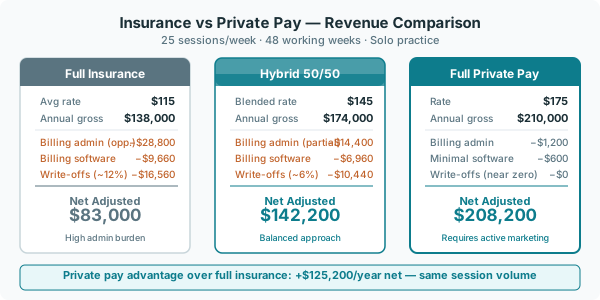
The Billing Model You Choose Shapes Your Entire Practice
Insurance vs private pay isn't just a revenue question, it's a decision about how much of your time goes to clinical work vs administrative overhead, how quickly you get paid, and what kinds of clients fill your schedule.
Most therapists start with insurance panels because it's easier to fill a caseload when you're accessible to clients with coverage. Over time, many shift toward private pay or hybrid models as they understand the actual cost of insurance participation.
Before making any changes, run your numbers with the therapist productivity calculator. Knowing your current effective hourly rate tells you exactly what your billing model is producing right now.
Reimbursement Rate Comparison
Insurance reimbursement rates vary by payer, by state, and by whether you're in-network or out-of-network. Here are realistic 2024 ranges for in-network CPT 90837 (53+ minute session):
| Payer Type | 90837 Rate Range |
|---|---|
| Medicaid | $65–$100 |
| Medicare | $105–$125 |
| BCBS (Blue Cross) | $100–$145 |
| Aetna | $95–$140 |
| United/Optum | $90–$135 |
| Cigna | $95–$140 |
| Private pay (self-set) | $120–$250+ |
The private pay ceiling is limited only by your market and your specialization. A therapist specializing in OCD with ERP training in a mid-sized city can reasonably charge $200–$250/session. A generalist in the same market on insurance panels gets $110–$130.
At 25 sessions/week for 48 weeks, the revenue difference between a $115 insurance blended rate and a $185 private pay rate is $84,000 per year.
The Admin Overhead of Insurance Panels
The insurance rate difference is real. But what you give up in exchange for insurance billing is time, and time has a dollar value.
Typical insurance admin overhead per week for a solo practice with 25 insurance clients:
- Claims submission: 2–3 hours/week (even with EHR automation)
- ERA review and payment posting: 1–2 hours/week
- Denial follow-up: 1–3 hours/week
- Authorization requests and renewals: 1–2 hours/week
- Credentialing maintenance (reappointments, updates): averaged out to ~1 hour/week
That's 6–11 hours of admin per week that a private pay practice simply doesn't do.
At a $100/hour opportunity cost (what you'd bill if those hours were clinical), insurance admin overhead costs a solo practice $28,800–$52,800 per year in foregone revenue, beyond the rate differential.
Credentialing Timelines
Getting credentialed with insurance panels is not fast. That's the piece therapists in training often don't hear about.
Average credentialing timelines by payer:
- Medicaid: 2–6 months (varies enormously by state)
- Medicare: 60–90 days typically
- Commercial payers (BCBS, Aetna, UHC): 90–180 days
- Optum/United behavioral health: Up to 6 months
During that window, you can't bill the payer. Any clients you see are private pay or go uncompensated. This creates a significant cash flow gap for new practices that budget based on anticipated insurance income.
Credentialing also requires active maintenance: CAQH profile updates, re-credentialing every 2–3 years, address and license updates. Each payer has its own requirements and timelines.
Sliding Scale Considerations
Many therapists offer sliding scale fees below their stated rate to serve clients who can't afford full fees. This is a values-driven choice, but it has real revenue implications.
A $150 standard rate with 5 clients on $80 sliding scale (in a 25-session week) reduces average rate from $150 to $136, a $16,800/year impact at that volume.
Sliding scale isn't inherently bad practice financially. But it should be intentional: decide how many sliding scale slots you'll offer, at what floor rate, and track what percentage of your caseload sits below full rate. Many therapists do this informally and don't realize their effective average rate is $20–$30 below their stated rate.
Use a community mental health fund or external low-fee referral source (Open Path Collective, Psychology Today's low-fee directory) to refer clients who need rates below your floor. This protects your revenue while maintaining your commitment to access.
Hybrid Models: The Practical Middle Ground
A fully private pay practice isn't realistic in every market. A fully insurance-based practice leaves money on the table for many therapists. Hybrid models offer a structured blend.
Common hybrid structures:
70/30 Insurance/Private Pay: Maintains insurance accessibility while reserving premium slots for private pay clients. Works well in mid-market cities where self-pay demand exists but isn't sufficient to fill a full schedule.
In-network for specific payers only: Credentialing with 2–3 high-reimbursing commercial payers (BCBS, Cigna) while declining Medicaid, Medicare, or lower-paying plans. Reduces admin burden while maintaining some insurance income.
Out-of-network (OON) billing: You charge your full rate; the client submits to insurance for partial reimbursement. You avoid insurance admin entirely. Requires clients with OON benefits and the ability to front the cost. Works well for practices serving higher-income demographics.
The revenue math for hybrid models is available in the private practice income calculator, enter your blended rate (weighted average across payment types) to get an accurate projection.
The Revenue Math: Worked Examples
Scenario A: Full insurance panel, 25 sessions/week
- Average rate: $115 (blended across payers)
- Gross: $138,000/year
- Insurance admin cost (6 hrs/week at $100/hr opp cost): ~$28,800
- EHR billing costs (~7%): ~$9,660
- Net adjusted: ~$99,540
Scenario B: Full private pay, 22 sessions/week (slightly lower volume to account for longer intake time)
- Rate: $175
- Gross: $184,800/year
- Minimal admin cost (~$1,200/year)
- EHR costs (low, no billing module needed): ~$600/year
- Net adjusted: ~$183,000
Scenario C: Hybrid 50/50, 25 sessions/week
- Average blended rate: $145
- Gross: $174,000/year
- Partial admin overhead: ~$14,400
- EHR billing costs (~4%): ~$6,960
- Net adjusted: ~$152,640
Private pay wins on net by a wide margin if the caseload is fillable. Hybrid wins over full insurance by $53,000/year in this model. See also private practice revenue: what therapists earn for context on these ranges.
Sources and Further Reading
- FAIR Health Mental Health Reimbursement Data (2024)
- CMS Medicare Fee Schedule, Behavioral Health
- Open Path Collective Low-Fee Therapy Network
- About This Calculator
- Private Practice Revenue: What Therapists Earn
- EHR Billing Tips That Maximize Reimbursement