EHR Billing Tips That Maximize Reimbursement
EHR billing for therapists: choose the right CPT code, cut claim denials, and get paid faster with these practical reimbursement strategies.
EHR Billing Is a Skill, Not an Afterthought
Most therapy training programs teach you how to do the clinical work. Almost none teach you how to get paid for it. That gap costs private practice therapists an estimated $8,000–$18,000 per year in underpayments, delayed reimbursements, and denied claims that never get worked.
Your EHR (electronic health record) system is the engine of your billing operation. Using it well, choosing the right CPT codes, scrubbing claims before submission, understanding remittances, makes a measurable difference in what actually lands in your bank account.
Check your current revenue efficiency with the therapist productivity calculator before and after making billing changes. The delta is often surprising.
Choosing the Right CPT Code
This is where the most money is quietly lost. Therapists often default to one CPT code for everything, regardless of session length.
The three core individual therapy CPT codes:
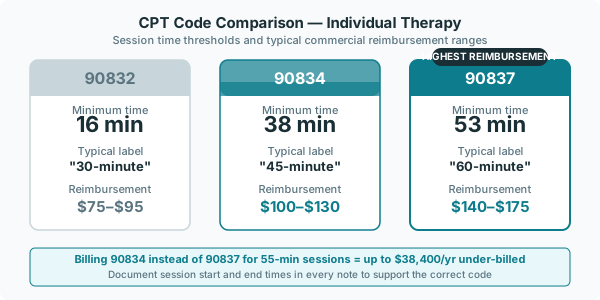
| Code | Session Length | Typical Commercial Reimbursement |
|---|---|---|
| 90832 | 16–37 minutes | $75–$95 |
| 90834 | 38–52 minutes | $100–$130 |
| 90837 | 53+ minutes | $140–$175 |
These are time-based codes. The session must meet the minimum time threshold to bill that code. A session that runs 40 minutes is 90834. A session that runs 54 minutes is 90837.
The most common mistake: billing 90834 for sessions that actually run 55–60 minutes because "that's just what we always use." Switching accurately documented 55-minute sessions from 90834 to 90837 is not upcoding, it's correct coding. And at a $30–$45 reimbursement difference per session, doing it accurately for 25 sessions per week adds up to $39,000–$58,500 per year in additional revenue.
Document start and end times in every note. This protects you in audits and ensures you're billing the right code every time.
Claim Scrubbing: Catch Errors Before Submission
A "dirty claim" is one with errors that cause a rejection or denial. The most expensive thing about dirty claims isn't the lost reimbursement on that claim, it's the time and administrative overhead to find, fix, and resubmit it.
Most modern EHRs (SimplePractice, TherapyNotes, Jane App) have built-in claim scrubbing that flags common errors before submission. Use it every time.
Common errors caught by claim scrubbing:
- NPI mismatch: billing NPI doesn't match credentialed NPI for that payer
- Date of service format errors: MM/DD/YYYY vs YYYYMMDD depending on payer requirements
- Missing or incorrect place of service code: 02 for telehealth, 11 for office, 10 for telehealth at patient home
- Diagnosis code not linked to procedure code: every CPT code needs a supporting ICD-10 on the claim
- Modifier omissions: telehealth often requires modifier 95 or GT; some payers require modifier 59 for certain code combinations
Running your claims through the scrubber adds roughly 2–4 minutes per claim. It saves 30–60 minutes per rejected claim in rework time. The ROI is obvious.
ERA vs EOB: Know What You're Reading
When payment comes back from a payer, it arrives as either an ERA (Electronic Remittance Advice) or an EOB (Explanation of Benefits).
- ERA is machine-readable, imports directly into your EHR, and auto-posts payments to the correct claims. Fast, accurate, and preferred.
- EOB is a paper or PDF document that requires manual reading and manual posting. Slower and more error-prone.
Most payers support ERA enrollment, you just have to enroll. Your clearinghouse (Waystar, Office Ally, Change Healthcare) handles the connection. If you're still receiving paper EOBs from major commercial payers, call their provider relations line and enroll in ERA immediately. This one change can save 3–5 hours of admin time per week in a busy practice.
Denial Management: The Revenue You're Leaving Behind
In the average therapy practice, 8–12% of claims get denied on first submission. The national average across all healthcare is around 9%. The problem isn't the denial rate, it's that only about 50% of denied claims ever get resubmitted.
Every unworked denial is lost revenue. A denial is not a final answer. Most denials fall into a few categories:
- Coverage terminated: verify insurance at every session, not just intake
- Timely filing: most payers require submission within 90–180 days of service
- Non-covered service: rare for standard therapy codes, but check your contract
- Prior authorization required: some payers require auth for ongoing treatment; flag these at intake
- Duplicate claim: you submitted twice; easy fix
Build a denial review process into your weekly admin time. 30 minutes per week working denials can recover $500–$2,000 per month depending on practice volume.
The Cost of Billing Errors: Real Numbers
A practice billing $180,000/year gross with a 10% denial rate and a 50% denial follow-up rate is leaving $9,000 on the table annually, before considering late payments, write-offs, and underpayments.
Underpayments are separate. If a payer is reimbursing you at $95 for 90837 when your contract rate is $130, that $35 difference on 20 sessions per week for 48 weeks = $33,600 in underpayments. You're owed this money. Most EHRs have a payment variance report that flags when payment doesn't match the contracted rate.
Run that report quarterly. File adjustment requests for underpayments within your contract's timely dispute window (usually 90–180 days).
EHR Platform Comparison: Billing Features
Not all EHR platforms are equal on the billing side.
SimplePractice: strong UI, good automated reminders, decent claim scrubbing. Billing can feel like a secondary feature to the scheduling tools. Best for solo and small practices.
TherapyNotes: billing-first design, robust denial tracking, excellent ERA integration. Steeper learning curve but better for practices where billing complexity is high.
Jane App: excellent for Canadian practices or multi-disciplinary clinics; growing US insurance support. More flexibility than SimplePractice for complex scheduling.
Whichever platform you use, the productivity impact comes from using all of its billing features, not just the scheduling and notes. A $49/month EHR doing 60% of what it can is more expensive than a $99/month EHR running at full capacity.
Sources and Further Reading
- AMA CPT Code Set Guidelines (2024 edition)
- CMS Place of Service Codes for Telehealth
- MGMA Behavioral Health Revenue Cycle Benchmarks
- About This Calculator
- How to Track Billable Hours as a Therapist
- The 50-Minute Hour: Origins and Billing Reality