The 50-Minute Hour: Origins and Billing Reality
The 50-minute therapy session has Freudian roots but real billing consequences. Learn how CPT codes define session length and what clients misunderstand.
Where Did the 50-Minute Hour Come From?
The "50-minute hour" is one of psychotherapy's most durable conventions, and one of its most misunderstood. Clients often arrive expecting a full 60 minutes. Therapists bill using time-based CPT codes that don't map neatly to either 50 or 60 minutes. And somewhere in the middle, revenue leaks out.
The 50-minute therapy session traces back to Freud, though not for the reasons most people assume. Early psychoanalytic practice used the "analytic hour" to mean 50 minutes of session plus 10 minutes of note-taking and transition between patients. The time was chosen practically, it allowed 6 sessions in a clinical workday without the sessions running into each other.
This convention passed through the mid-20th century largely unchanged and became the default for most outpatient therapy models in the U.S. It's now baked into client expectations, training programs, and, confusingly, the fee structures many therapists still use.
The CPT Code Reality
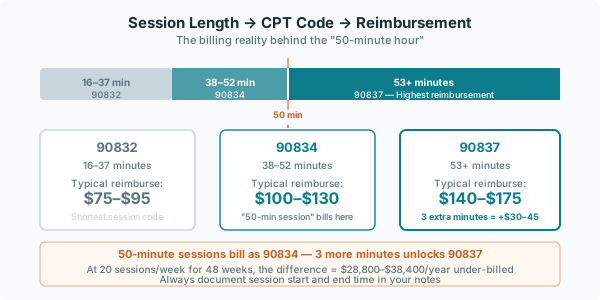
Here's where the convention collides with billing. The three standard individual therapy CPT codes are not defined by "50 minutes" as a unit. They're defined by time thresholds:
| CPT Code | Minimum Time | Common Description |
|---|---|---|
| 90832 | 16 minutes | Psychotherapy, 30 minutes |
| 90834 | 38 minutes | Psychotherapy, 45 minutes |
| 90837 | 53 minutes | Psychotherapy, 60 minutes |
A 50-minute session falls under 90834: not 90837. To bill 90837, the highest-reimbursing standard therapy code, your session must meet or exceed 53 minutes of face-to-face time.
This creates a specific billing trap: therapists who run "50-minute sessions" as their standard practice and bill 90834 are being accurate. But therapists who run sessions that routinely hit 55–60 minutes and still bill 90834 are *under-billing*.
At a $30–$40 reimbursement differential between 90834 and 90837, under-billing 20 sessions per week for 48 weeks = $28,800–$38,400 in uncollected revenue per year.
Billing 45 vs 50 vs 53 Minutes: The Practical Impact
Let's map out the billing reality for different session lengths:
45-minute sessions:
- CPT code: 90834
- Typical commercial reimbursement: $100–$130
- Notes: This is the clean midpoint of 90834. Efficient for practices wanting to see 7–8 clients per day.
50-minute sessions:
- CPT code: 90834
- Typical commercial reimbursement: $100–$130
- Notes: Session length must meet 38-minute minimum; 50 minutes qualifies comfortably. But if you're running to 50, you're 3 minutes short of the 90837 threshold.
53–60 minute sessions:
- CPT code: 90837
- Typical commercial reimbursement: $140–$175
- Notes: This is where most therapists who do "full hour" sessions actually land. If your sessions consistently run 55+ minutes, document accordingly and bill 90837.
The key operational implication: decide what your standard session length actually is and structure your schedule accordingly. A therapist running 90837 sessions needs 15-minute transition gaps between sessions (not 10-minute), which changes day capacity.
Using the therapist productivity calculator, you can see how session length choice affects your daily session capacity and annual revenue projection.
What Clients Think vs Billing Reality
Most clients have no idea how CPT codes work. What they think:
- "I'm paying for an hour", even when the session is 50 minutes
- "The 10 minutes is for notes", partly true historically, but not how billing works now
- "My insurance pays for 60-minute sessions", insurance pays for a CPT code, not a specific clock duration
These mismatches create awkward conversations when clients notice their session ending at 50 minutes while paying a "60-minute rate." Setting expectations at intake prevents most of this friction.
A simple intake disclosure: "Our standard sessions are 53–55 minutes of face-to-face time. We bill CPT 90837 for this length. If a session runs shorter due to a clinical decision, I'll bill the appropriate code."
This kind of transparency prevents billing surprises and manages the "therapy hour" expectation realistically.
The "Therapy Hour" Myth
The term "therapy hour" persists in client-facing marketing and even among clinicians. It means different things to different people:
- To some therapists: a billing unit (whatever CPT code they typically use)
- To some clients: 60 full minutes
- To Freudian tradition: 50 minutes of session + 10 minutes transition
- To CPT coding: a time threshold based on face-to-face minutes
None of these definitions align perfectly. The practical consequence is that "I charge $150 per session" is more accurate than "I charge $150 per hour" unless you're actually delivering 60 face-to-face minutes and billing 90837.
Private pay practices have the most flexibility here, you set your own rate for whatever session length you offer. $150 for a 45-minute session and $150 for a 55-minute session are both legitimate as long as the fee agreement is clear.
Insurance billing, however, requires accurate CPT coding regardless of what you call the session in client-facing materials. Billing 90837 for a 48-minute session is a documentation compliance issue. If you're audited, the time must match the code.
Documentation Requirements for Time-Based Codes
Because 90832, 90834, and 90837 are time-based, your session notes need to document start and end times (or explicitly state session duration).
This isn't optional. CMS and commercial payers can audit time-based codes. A note that says "client presented with anxiety and discussed CBT techniques" without a documented session duration doesn't support any particular CPT code.
Standard documentation approach:
- State session start and end time at the top of the note
- Or include a statement like "Session duration: 54 minutes"
- Document face-to-face time only (not documentation time)
This takes 5 seconds per note. Not doing it creates real audit exposure. See EHR billing tips for therapists for more on documentation best practices.
Optimizing Session Length for Revenue and Schedule
From a pure revenue-per-day standpoint, the math on session length looks like this:
8-hour clinical day with 45-minute sessions (90834), 15-min transitions:
- Sessions: 8 (every 60 minutes)
- Revenue at $115/session: $920/day
8-hour clinical day with 53-minute sessions (90837), 15-min transitions:
- Sessions: 7 (every 68 minutes)
- Revenue at $155/session: $1,085/day
8-hour clinical day with 53-minute sessions (90837), 10-min transitions:
- Sessions: 7 (every ~63 minutes, tight)
- Revenue at $155/session: $1,085/day
The 90837 model with slightly longer transitions actually earns more per day even with one fewer session. The math is sensitive to the rate differential in your market, run your specific numbers with the session revenue calculator.
Sources and Further Reading
- AMA CPT Code Set, Psychiatry Section (2024)
- Makover, R.B., *Treatment Planning for Psychotherapists* (on the analytic hour origin)
- CMS Documentation Guidelines for Time-Based E&M Codes
- About This Calculator
- EHR Billing Tips That Maximize Reimbursement
- How to Track Billable Hours as a Therapist