Telehealth vs In-Person: Which Pays More?
Telehealth vs in-person therapy productivity compared: overhead, no-show rates, geographic reach, and which model generates more net revenue per hour.
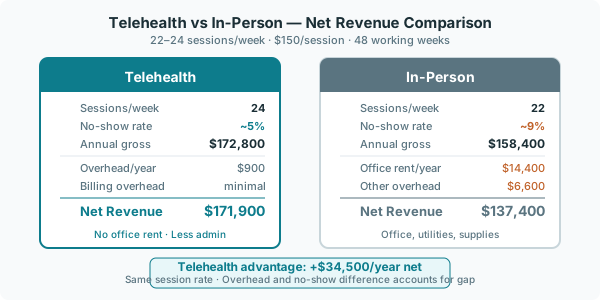
The Real Comparison Isn't What You Think
Most therapists frame telehealth vs in-person as a clinical question. The client experience angle matters, some clients genuinely do better in person. But if you're asking which model *pays more*, that's a pure business math question.
And the answer depends on variables that are specific to your practice: your location, your overhead structure, your client population's no-show tendencies, and what parity laws apply in your state.
Let's work through the numbers. Start by calculating your current revenue per hour with the therapist productivity calculator. That's your baseline to compare against.
No-Show Rate Differences
This is the most significant productivity variable between the two modalities, and it consistently favors telehealth.
Research published in the *Journal of Behavioral Health Services & Research* found that telehealth appointments in outpatient mental health had no-show rates of 4.8% versus 9.1% for in-person appointments, nearly half. Other studies show a 15–40% reduction in no-shows when clients switch from in-person to telehealth.
Why? Reduced friction. No commute, no parking, no time off work. A client who would cancel an in-person session because they're having a bad mental health day often still logs onto telehealth because the barrier is lower.
For a practice with 25 scheduled sessions per week at $150/session:
- In-person at 9% no-show: 22.7 completed sessions/week → $177,060/year
- Telehealth at 5% no-show: 23.75 completed sessions/week → $171,000/year
Wait, the telehealth number is slightly lower here because the rate is $150 for both. The no-show advantage alone doesn't always close the revenue gap without factoring in overhead.
Overhead Comparison
This is where telehealth wins decisively for solo and small practices.
In-person overhead (solo practice, one office):
- Office rent: $800–$1,800/month (market dependent)
- Utilities: $100–$200/month
- Office supplies, cleaning, furniture: $200–$400/month
- Total: $1,100–$2,400/month, or $13,200–$28,800/year
Telehealth overhead (home office or virtual):
- HIPAA-compliant video platform: $20–$50/month
- Broadband upgrade (if needed): $30–$50/month
- Home office setup: one-time cost, ~$500–$1,500
- Total recurring: ~$50–$100/month, or $600–$1,200/year
The overhead difference is $12,600–$27,600 per year. That's not a rounding error, it's the difference between a profitable practice and a marginal one, especially in a high-rent metro.
At $150/session with 22 completed sessions per week for 48 weeks:
- Telehealth net: $158,400 gross − $900 overhead = $157,500
- In-person net: $158,400 gross − $21,000 overhead = $137,400
Telehealth wins by $20,100 per year net, at identical session rates and similar session volumes.
Geographic Reach and Caseload Flexibility
Telehealth removes your practice's geographic ceiling entirely.
An in-person practice in a rural area or small city may have a natural client pool ceiling, once you've reached most of the local demand for your specialty, growth requires adding staff or moving. A telehealth practice can pull clients from anywhere in your licensed states.
This matters especially for specialty niches: eating disorders, OCD (with ERP training), sex therapy, perinatal mental health. Specialists doing telehealth regularly maintain waitlists 3–6 months long by drawing from an entire state rather than a 20-mile radius.
Telehealth also allows greater scheduling flexibility. Sessions at 6am, 8pm, or Saturday afternoons become feasible when neither you nor your client needs to commute. This flexibility can let you capture client segments, shift workers, parents with young children, traveling clients, that in-person scheduling can't serve.
Telehealth Parity Laws
As of 2024, 43 states have telehealth parity laws requiring commercial insurers to reimburse telehealth at the same rate as in-person services for behavioral health. An additional 4 states have partial parity protections.
This means in most states, you bill 90837 for a telehealth session and get paid the same as for an in-person 90837. The reimbursement is equivalent. You're not taking a rate cut to offer telehealth.
Medicare and most Medicaid programs also cover telehealth behavioral health services following COVID-era regulatory changes that have largely been made permanent.
Check your state's specific parity laws if you're billing insurance. And ensure you're using the correct place of service code: 02 (telehealth provided in a facility) or 10 (telehealth at patient's home) depending on your payer's requirements. See EHR billing tips for therapists for more on correct telehealth claim submission.
Schedule Flexibility and Revenue Per Hour
The productivity advantage of telehealth shows up clearly in revenue per available hour.
Without commute, setup, and between-session transitions, a telehealth therapist can schedule sessions with 10-minute gaps vs the 15–20 minute buffers typically needed in-person. Over a 7-session day, that recaptures 35–70 minutes, enough to potentially fit an 8th session.
At $150/session, one additional session per day × 4 days/week × 48 weeks = $28,800/year in additional capacity.
You don't have to fill it. But the capacity is there in a telehealth model and often isn't in an in-person one.
Revenue Per Hour: The Bottom Line
Assuming similar session rates and benchmark productivity (70%):
| Model | Sessions/Week | Rate | Gross/Year | Overhead/Year | Net/Year |
|---|---|---|---|---|---|
| Telehealth | 24 | $150 | $172,800 | $900 | $171,900 |
| In-Person | 22 | $150 | $158,400 | $21,000 | $137,400 |
| In-Person premium | 22 | $175 | $184,800 | $21,000 | $163,800 |
In-person at the same rate loses on net. In-person *can* win if you can command a $25+/session premium, which is feasible in some urban markets where clients pay a premium for face-to-face work.
The honest answer: telehealth wins on net revenue for most solo practices. In-person wins only if the premium rate is achievable and the overhead is low. Hybrid practices often land in the best position, telehealth flexibility with in-person availability for clients who genuinely need it.
Run your own comparison with the hourly revenue and productivity tool.
Sources and Further Reading
- Journal of Behavioral Health Services & Research, Telehealth No-Show Rates (2022)
- CMS Telehealth Flexibilities, Mental Health Provisions
- NCSL State Telehealth Parity Laws Tracker (2024)
- About This Calculator
- Insurance vs Private Pay: Productivity Impact
- EHR Billing Tips That Maximize Reimbursement